
Guides
How to Choose a Cat Wand Toy: A UK Buyer's Checklist
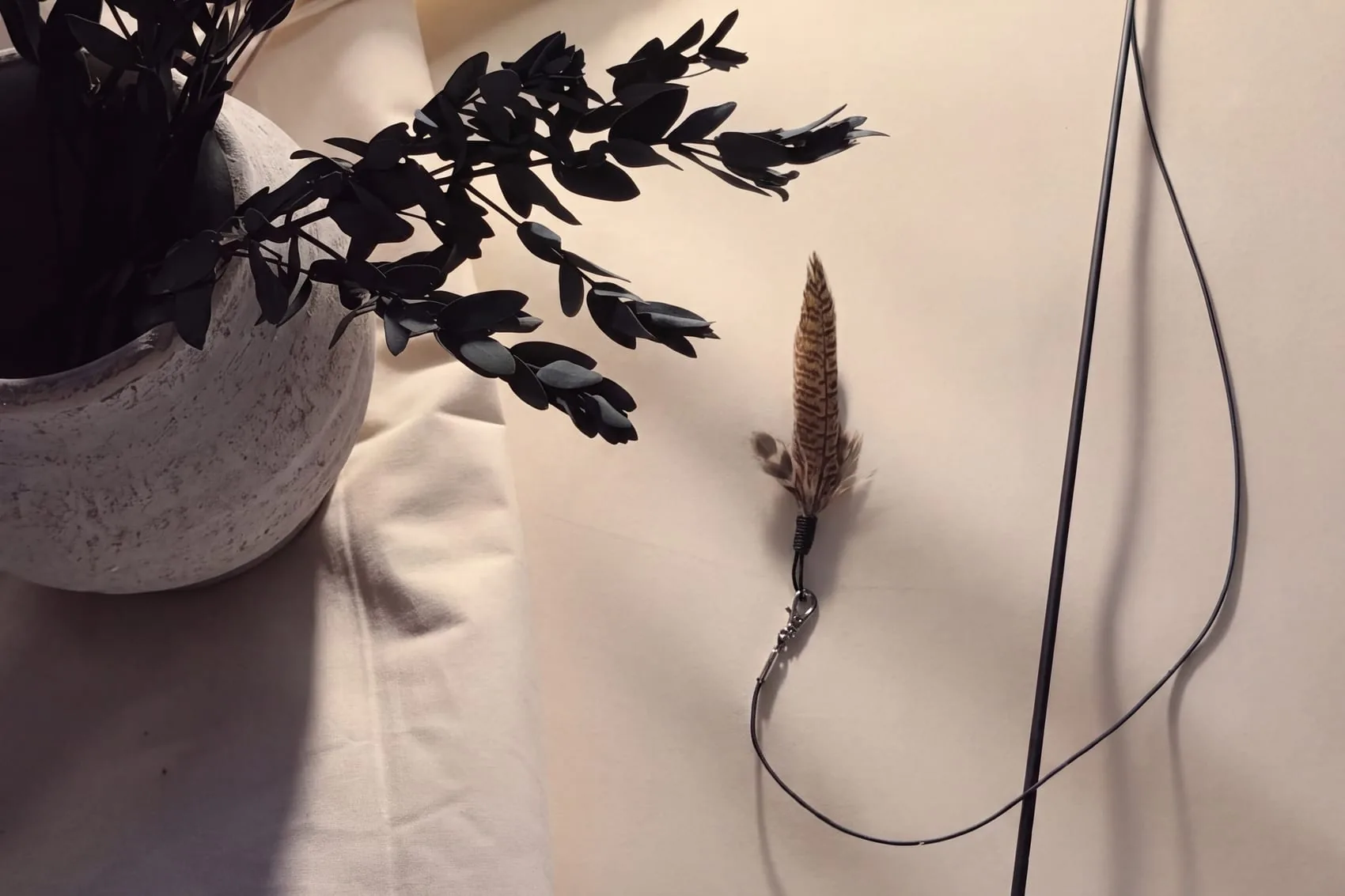
The feathers are gone by Thursday. By the weekend the string has wound itself round the rod, and the rod has a split where two sections slide together. Plenty of cat owners have binned a wand like this, then bought the same one again.
It is worth getting right, because cat charities recommend this kind of toy by name. International Cat Care asks owners to play with each cat for at least five minutes every day with a wand toy (opens in a new tab). Cats Protection calls the fishing rod toy one of the best toys for indoor cats (opens in a new tab).
In short: a good cat wand (also sold as a fishing rod toy or cat teaser) has a one-piece, flexible rod, a braided low-stretch cord with a swivel, and a lure that clips off so you can replace it cheaply. It should be long enough to keep the lure well away from your hand, and it needs a place to live out of the cat's reach between sessions.
What makes a good cat wand toy?
Ask these ten questions before you buy. The sections below explain why each one matters.
- Is the rod one continuous piece, or telescoping sections?
- Does the rod bend deeply and spring back straight?
- Is the cord braided and low-stretch, or cotton string and elastic?
- Is there a swivel where the cord meets the rod?
- Does the lure clip off, or is it glued or knotted on?
- Can you buy a new cord and lure on their own, and what do they cost?
- Is the rod plus cord long enough to keep the lure well away from you?
- Is the handle comfortable for a ten-minute session?
- Is there somewhere safe to store it?
- What does the warranty cover, and where do returns go?
How can you tell a good cat wand from the listing?
Buying online, you are judging from photos and a description. These are the signs to look for.
| Question | Good sign | Warning sign |
|---|---|---|
| Rod | "One-piece", a named material such as fibreglass | Push-button or sliding sections, "extendable" |
| Cord | Cord named by material, such as Dyneema | "String" or "elastic" with no material given |
| Swivel | A swivel shown at the rod tip | Cord tied straight onto the rod |
| Lure | A clip or loop you can open | Feathers glued into a plastic body |
| Spare parts | A refill listed with its own price | "Replacement heads" sold only as a full new wand |
| Length | Rod and cord lengths both given | No measurements, or one combined figure |
| Storage | A mount or case included or sold separately | Nothing mentioned |
Is a one-piece rod better than a telescoping one?
For durability, yes. A telescoping rod packs away small, but each joint is an extra place where the rod can loosen, jam or split when a cat pulls hard to one side. A one-piece rod has no joints to fail.
The material matters as much as the shape. Carbon fibre is about five times stiffer than fibreglass but not five times stronger (opens in a new tab), according to a composites engineer at the makers of West System epoxy. So for a similar strength, a fibreglass rod bends further before it reaches its limit. A cat's pull is sudden and sideways, so a rod that gives a little is the safer choice. There is more on handles and rods in what makes a cat wand last.
What cord should a cat wand have?
A braided synthetic cord that barely stretches, joined to the rod with a swivel. Dyneema, a type of high-performance polyethylene, is described by one UK rope supplier as having very low stretch under load and minimal water absorption (opens in a new tab). Cotton string, by contrast, soaks up saliva and frays.
The swivel matters more than it looks. It lets the two lengths of line rotate independently of each other (opens in a new tab), so a spinning lure is less likely to twist the cord.
No cord makes a toy indestructible. If your cat shreds lures, choose a wand where the lure clips off and a replacement costs a few pounds. A wrecked lure then becomes a small expense, and the rod carries on.
Where should you store a cat wand?
Out of reach, every time. Cat-care guidelines from the American Association of Feline Practitioners and the International Society of Feline Medicine, as summarised by VCA, say to put away toys with strings or other parts that can be ingested after play (opens in a new tab). Cats Protection says the same: store toys safely out of reach after use (opens in a new tab).
The reason is serious. Swallowed string can cut into the wall of the intestine (opens in a new tab). A UK vet's advice is never to pull on string you can see, and to call your vet straight away. A wall mount or a high cupboard works. A wand left on the sofa does not.
Which cat wand suits your cat?
Match the reach, the lure and the pace of play to your cat. How to run a session is covered in how to play with your cat.
Kittens. Start early. The Feline VMA and International Cat Care advise introducing interactive play young so cats learn to avoid going after your hands and feet (opens in a new tab). A wand keeps the lure well away from your fingers.
Cats that hunt. Choose reach and a sturdy cord. In a University of Exeter study, owners played with their cats using a feather toy on a wand, and 5 to 10 minutes a day cut the prey cats brought home by about a quarter (opens in a new tab).
Indoor or bored cats. The RSPCA says indoor cats need more to keep them entertained (opens in a new tab). Cats Protection notes that cats can't see well under 25 centimetres (opens in a new tab) and prefer a toy moving away from them, so a longer rod and cord gives you room to make the lure behave like prey.
Older cats. Keep the lure low and the movements slow. In a US study of 100 cats over 12, 90% had signs of joint disease on X-rays (opens in a new tab). A vet writing for PetMD suggests short-duration and low-impact games with a cat wand (opens in a new tab). If an older cat has stopped playing altogether, ask your vet about joint pain.
More than one cat. Play with them one at a time. The same Feline VMA and International Cat Care guidance says to play with them individually (opens in a new tab). A second lure on hand makes the swap quick.
Cats that ignore toys. Change the lure before you give up on the cat. In a study of adult cats, play almost stopped after three sessions in a row with the same toy, then came back strongly when it was swapped (opens in a new tab) for one in contrasting colours. Let the cat catch the lure often, too: cats need to capture the "prey" at least intermittently, to prevent frustration (opens in a new tab).
What should UK buyers check before ordering?
Check where the wand ships from, what delivery costs and where returns go. When you buy online from a UK seller, you can cancel up to 14 days after the order is delivered (opens in a new tab) without giving a reason. A UK returns address makes that easy to use.
Then read the warranty. The cord and lure are made to wear, so the useful part is what it says about the rod and handle, and for how long.
How does The Chaser measure up?
We make The Chaser, so here is how it measures up. It has a walnut handle, a one-piece solid fibreglass rod of about 90 cm, and a Dyneema cord of about 65 cm with three swivels. The pheasant-feather lure, the Wren, clips off. A Refill Pack with a new cord and Wren is £14. A walnut wall mount, the Cradle, is included. The Chaser is £49, with a one-year warranty on the handle and rod and 30-day returns from delivery.
It is on pre-order now, dispatching in January 2027, and we deliver within the UK only. Delivery is complimentary on orders of £30 or more. See The Chaser (opens in a new tab).