
Cat Behaviour
My Cat Ate String: What to Do, and How to Use a Wand Safely
If your cat has swallowed string, thread or part of a toy, call your vet now, even if your cat seems fine. Do not pull any string you can see, and do not try to make your cat sick.
In short: swallowed string is an emergency in cats. One end can catch under the tongue or in the stomach while the rest is pulled into the gut, which bunches up around it. UK vet charity PDSA advises calling a vet straight away and never waiting to see what happens. A wand toy is meant to be played with while you hold it, and put away out of reach when play ends.
This page is general information drawn from vets and animal charities, not veterinary advice. If you are worried, call your vet or an out-of-hours vet.
My cat ate string. What should I do right now?
Tell your vet what your cat swallowed, roughly how much and when. PDSA advises (opens in a new tab) contacting a vet as soon as a cat swallows something that could cause a blockage, even before any symptoms show, and warns that delay can make a cat very ill.
If you saw it happen, your vet will usually check under the tongue for a loop of string. Cornell's CatWatch newsletter (opens in a new tab) (March 2023) says that if all looks well, a vet may send the cat home on several high-fibre meals a day for a few days, to help carry the string through.
Do not try to make your cat sick at home. PDSA says so plainly, and CatWatch adds that hydrogen peroxide does not work in cats and can be dangerous for them.
Should I pull out string hanging from my cat's mouth or bottom?
No. Leave it where it is and go to the vet. PDSA says never pull (opens in a new tab) string hanging from a cat's mouth.
The same goes for string showing under the tail. Board-certified veterinary surgeon Jan MacDonald, quoted in CatWatch, warns that pulling on it in a cat with signs of a blockage (opens in a new tab) is likely to damage the intestines further. Cutting the visible end may not help either, because the bunching inside stays where it is.
What are the warning signs?
Go to a vet now if your cat could have swallowed string or part of a toy and shows any of these, drawn from PDSA (opens in a new tab), VCA Animal Hospitals (opens in a new tab) and CatWatch (opens in a new tab):
- String visible in the mouth, around the tongue or under the tail
- Vomiting or gagging
- Off food, or not drinking
- Low energy, or hiding more than usual
- A sore belly, or growling or biting when picked up
- Drooling, lip smacking or pawing at the mouth
- Pooing less than usual, or straining in the litter tray
My cat ate string but is acting normal. Is that OK?
Not necessarily. Seeming normal does not mean the string has passed, which is why PDSA asks owners to call a vet even when there are no symptoms yet. There is no safe number of days to wait at home.
Whether string will pass, and how long it might take, is for your vet to judge, often with an X-ray or ultrasound.
Why is string so dangerous for cats?
Vets call a swallowed length of string, thread, yarn or tinsel a linear foreign body. VCA describes it (opens in a new tab) as an especially dangerous kind of foreign body, and most common in cats. PDSA lists string and thread among the most common causes of gut blockage in cats (opens in a new tab).
The harm comes from how it lodges. One end catches, often around the base of the tongue or in the stomach, while the gut keeps trying to move the rest along. Because it cannot, the intestine gathers up on the string like fabric on a drawstring. CatWatch explains that the string can then saw through the intestinal wall and leak gut contents into the abdomen, causing peritonitis, which can be life-threatening.
Cats are also badly built for spitting string out. Their tongues carry small backward-pointing spines, and VCA notes (opens in a new tab) that once thread is in the mouth, those spines hold it in.
How is it treated, and what does surgery cost?
Usually with emergency surgery, plus fluids, pain relief and antibiotics. Because the bowel is bunched, CatWatch notes that a surgeon may need many small incisions, removing the string a short length at a time. Badly damaged sections of intestine sometimes have to come out, and VCA explains (opens in a new tab) that the operation is usually regarded as higher risk than removing other kinds of foreign body.
Many cats recover well. PDSA tells the story of Bear, a six-month-old kitten (opens in a new tab) who swallowed the netting from a Christmas beef joint. Two inches of his intestine had to be removed, he went home the next day and he made a full recovery. His treatment at the charity cost £843.09.
Private fees are often higher. The insurer Animal Friends says claims for swallowed objects in cats average £1,834 (opens in a new tab), a figure that covers all foreign bodies, not string alone.
Are feather toys and cat wands safe?
They are fine to play with together, and risky to leave lying around. The concern vets raise is pieces a cat can bite off and swallow, feathers included, and the string a lure hangs from.
Staff at the University of Wisconsin School of Veterinary Medicine (opens in a new tab) note that cats who chew hard will swallow feathers, strings and sparkles, so those toys are best avoided for heavy chewers. They also suggest toys of sturdy construction with no loose decorations, and removing any piece that gets chewed off. If your cat tries to eat the lure rather than catch it, switch to a different kind of play.
How do I use and store a cat wand safely?
Hold the wand for the whole session, then put it away where your cat cannot reach it. Dr MacDonald's prevention advice is simply not to leave yarn or thread anywhere a curious cat can find it, and PDSA asks owners to keep string out of reach.
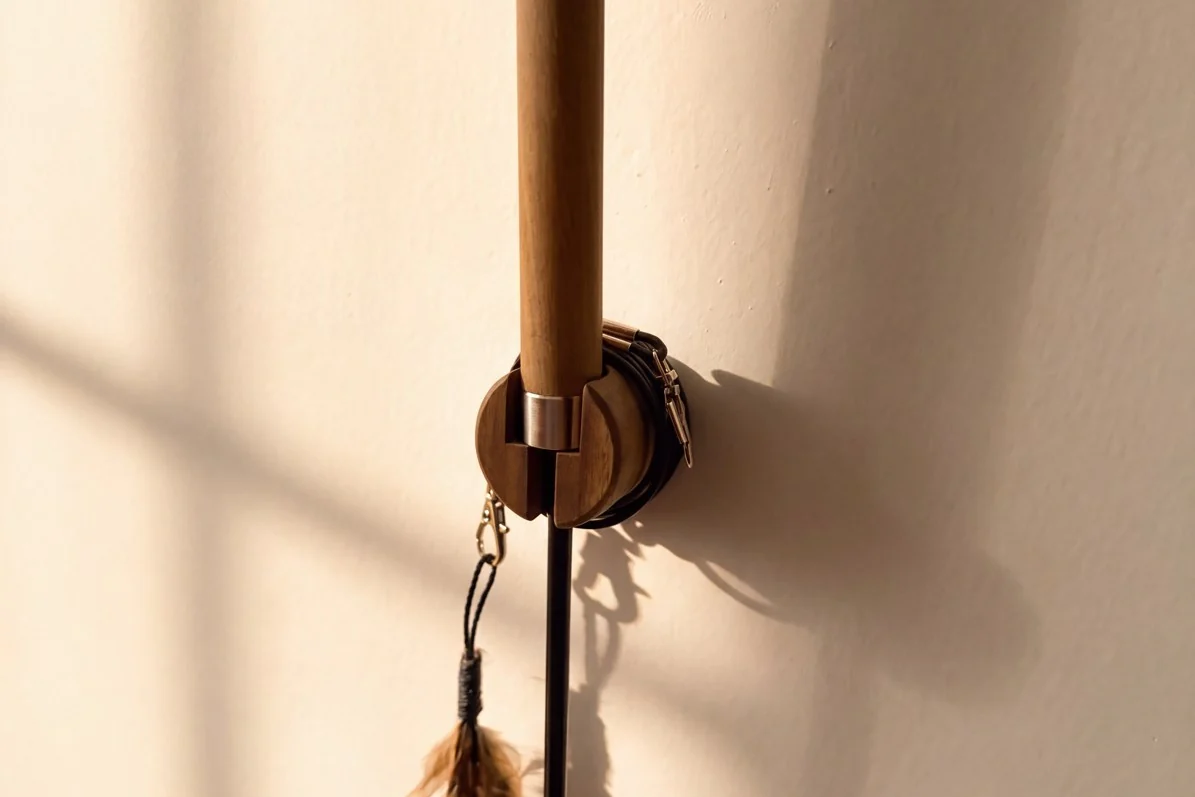
A drawer or a high hook works. We made the Cradle, the walnut wall mount that comes with The Chaser (opens in a new tab), for this job: the wand hangs on the wall between sessions, and you can fix it high enough that your cat cannot get to it.
Fraying, a flattened patch of cord or a lure that has started to shed are signs to replace that part. Even Cats Protection's make-your-own string toy sheet (opens in a new tab) for children ends by saying to keep an eye on your cat, and to take the toy away if they start eating any part of it.
On The Chaser, the cord and the Wren feather lure clip off, so when either shows wear you can swap in a Refill Pack (opens in a new tab) rather than replacing the wand.
Safe wand habits:
- Keep hold of the wand the whole time you play
- Check the cord and lure before each session
- Replace worn cord or a shedding lure
- Stop if your cat chews or eats the lure
- Put the wand away, out of reach, as soon as play ends
If anything on this page sounds like your cat today, call your vet.