
Materials & Craft
What Makes a Cat Wand Actually Last
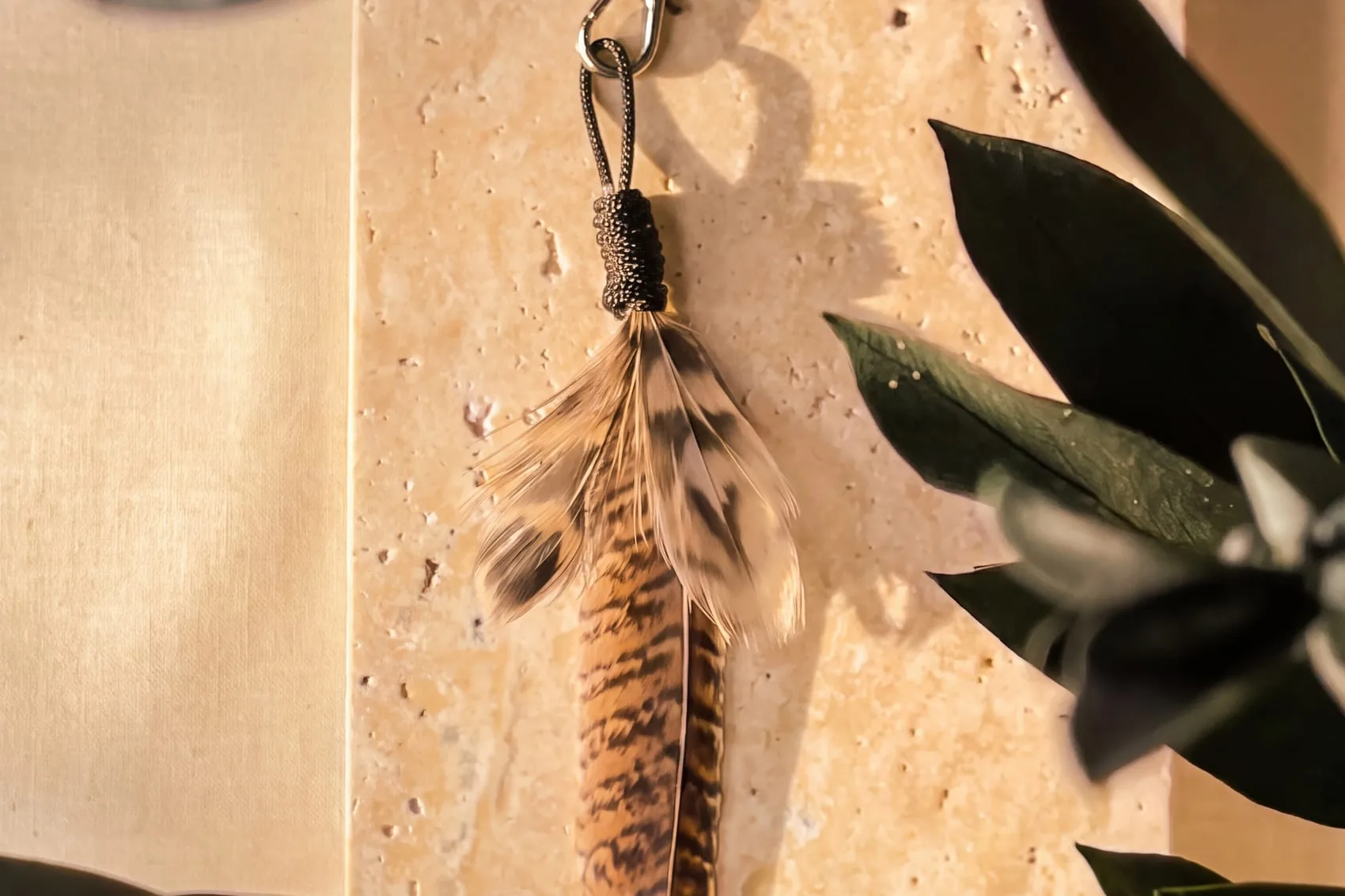
You know the cycle. You buy a cat wand. Your cat loves it. Two weeks later the string is frayed, the handle is cracked, the feathers are gone, and the whole thing goes in the bin. You buy another one. Repeat.
The average cat wand from a pet shop is designed to be replaced, not to last. Plastic handles, telescoping rods with weak joints, cotton string that unravels after a few sessions. These aren't engineering failures. They're design choices. Cheap materials keep the price low and the repurchase rate high.
But it doesn't have to work like that. The difference between a wand that lasts two weeks and one that lasts years comes down to four components: the handle, the rod, the cord, and the connection system.
The handle
Most cat wands use injection-moulded plastic or foam-wrapped dowel. They're light, cheap, and uncomfortable to hold for more than a few minutes. Cork is a step up. It's warm to the touch and lightweight, but it's soft. Over time it dents, compresses, and absorbs oils from your hands.
Walnut is the material you find in high-end tool handles, knife scales, and gunstocks. There's a reason for that. Black walnut has a Janka hardness rating of 1,010 lbf - harder than cherry, softer than oak - right in the sweet spot where it's dense enough to resist wear but light enough to feel balanced in your hand. It has natural shock resistance, meaning it absorbs impact without cracking. And unlike plastic or cork, walnut develops a patina over time. It gets better with use, not worse.
When we designed The Chaser, the handle was the first decision we made. Walnut, shaped to sit naturally in your grip during a play session without fatigue. It's the part of the wand you touch every single time, so it had to feel like something worth picking up.
The rod
This is where most wands fail. There are three common rod materials in cat toys:
Telescoping plastic. The most common. Multiple thin sections that slide inside each other. Convenient for storage, terrible for durability. The joints are the weakest point. Aggressive play puts lateral stress on those connections, and they snap. It's not a question of if, it's when.
Carbon fibre. Lightweight and stiff. Popular in fishing rods and high-performance applications. But stiffness is actually a problem for cat wands. Carbon fibre resists bending, and when it does bend past its threshold, it doesn't flex back. It fractures. A cat yanking sideways on an attachment can snap a carbon fibre rod cleanly. It's also brittle on impact. Drop it on a hard floor and you might crack it.
Fibreglass. This is what we use. Fibreglass has roughly a third of carbon fibre's stiffness, which means it flexes deeply under load and springs back. It bends without breaking. Fibreglass is the material used in fishing rods that need to absorb the unpredictable force of a fighting fish, and it's the right material for a cat wand for the same reason. Your cat's movements are fast, lateral, and unpredictable. The rod needs to move with them, not against them.
The Chaser uses a solid fibreglass rod, tapered so it's stiffer where it meets the handle and whippier at the tip where the action happens. No joints. No telescoping sections. No weak points.
The cord
Cotton string is what you'll find on most wands. It frays, absorbs saliva, weakens when wet, and tangles constantly. Paracord is better, but cats that chew will eventually get through it.
The Chaser uses Dyneema cord. Dyneema is a brand of ultra-high-molecular-weight polyethylene (UHMWPE). Weight for weight, it's up to 15 times stronger than steel. It was originally developed for mooring lines on offshore oil rigs and rigging on racing yachts. It's hydrophobic (doesn't absorb water or saliva), resistant to UV degradation, and has excellent abrasion resistance.
For a cat wand cord, this means it won't fray, won't weaken from moisture, and won't tangle the way cotton or nylon does.
The connections
This is the detail most wand makers ignore entirely. The point where the cord meets the rod, and where the attachment meets the cord, is where most failures happen. A fixed knot is the weakest link. Glue joints degrade. Crimps slip.
The Chaser uses three 360° swivels - one at the rod-cord junction, and one in each of the lobster clips at the ends of the cord. The swivels prevent the cord from twisting during play, which is what causes tangles and eventual cord failure on other wands. The lobster clips allow you to swap attachments in seconds without retying anything.
This modular system means the cord and attachments are replaceable without replacing the wand. The rod and handle are the permanent chassis. Everything else clips on and off.
The maths
A £3 wand from a pet shop lasts, generously, three weeks of daily play. That's roughly 14p per play session. Over a year, you're spending around £51 on disposable wands.
The Chaser is £49 (Founding Edition). With a fibreglass rod that doesn't snap, Dyneema cord that doesn't fray, and a walnut handle that gets better with age, the wand itself should last years. Replacement attachments extend its life indefinitely.
The expensive option is the one you keep replacing.