
Materials & Craft
Cat Wand String Keeps Breaking? Which String to Use Instead
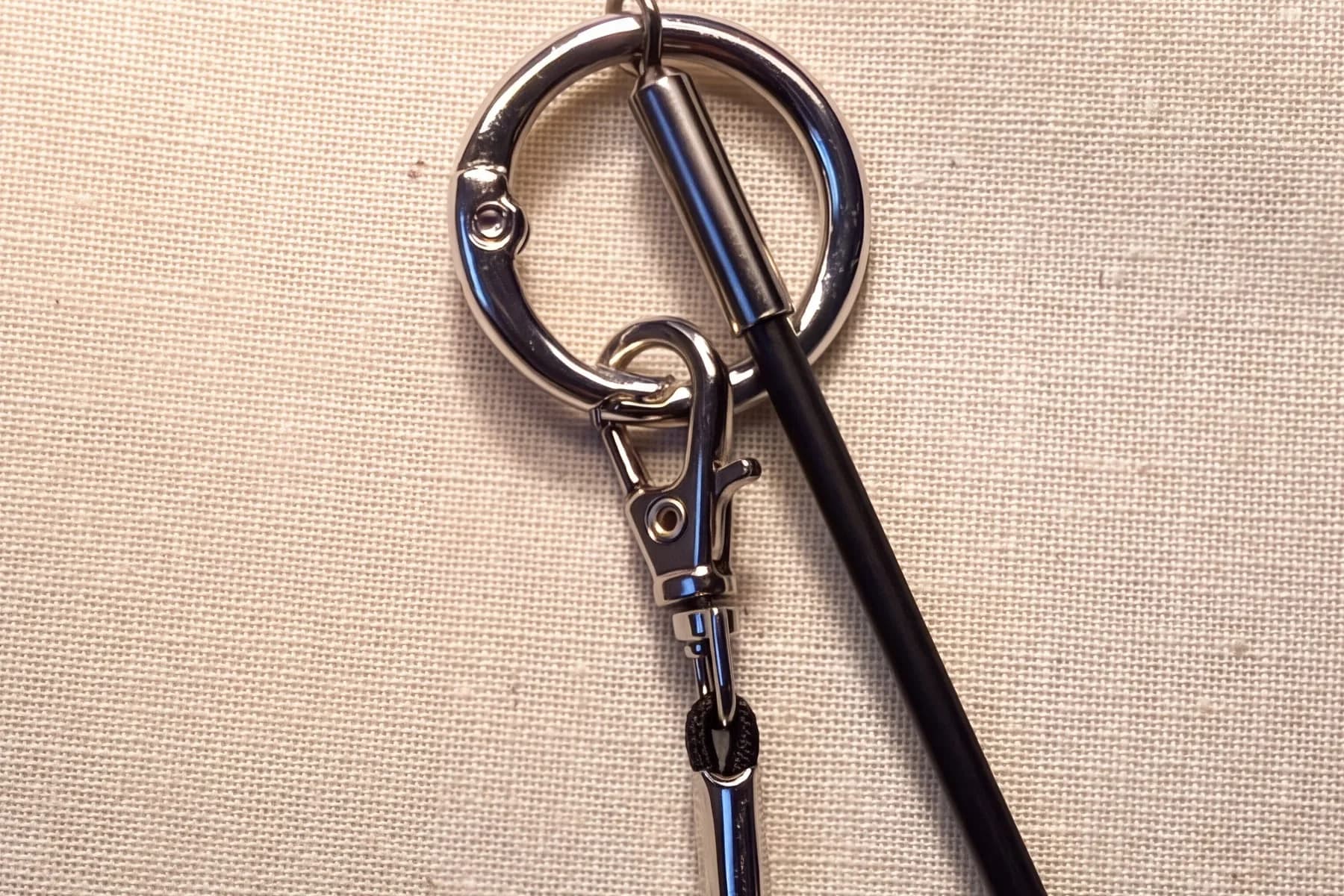
You know the moment. Your cat makes the catch, gives one good pull, and the string goes. The feather is under the sofa, a frayed end hangs from the stick, and the wand heads for the bin.
Cat wand string rarely breaks because it was too weak. It breaks because something wore it thin first: chewing, saliva, claws or a knot, until an ordinary tug finished it. So the best string for a cat toy is the one that wears slowest, and strength is only part of that.
In short: most wand string fails from wear, not from one strong pull. Cotton soaks up water and frays, elastic loses its stretch, and nylon and paracord stretch and fuzz. Dyneema is thin, barely stretches and does not take on water. The Chaser uses a 2 mm Dyneema cord with a clip at each end, so it can be replaced without tying a knot.
How strong does cat wand string need to be?
Nobody knows exactly. No one has published a measurement of how hard a cat pulls on a toy, so any exact figure you see is a guess.
The nearest credible number is jaw strength. A 2020 study of stray and feral cats in Western Australia estimated average bite force at 206 newtons for males and 172 for females (opens in a new tab), worked out from the skulls of 268 cats rather than measured on live bites. That is roughly the force of 18 to 21 kg hanging still.
A bite is a squeeze between the teeth, and a pull on a string is a different thing, so treat that figure as a sense of scale. Thin cotton twine is rated at about 14 kg when new, below that bite figure, while 2 mm nylon and Dyneema are rated many times above it. What matters after that is how much strength is left after months of play.
Why does cat wand string keep breaking?
A cord breaks at its weakest point, and on a wand that is almost never the middle of a clean length. It is a knot, a patch frayed by claws, or a spot softened by chewing.
Knots cost more than most people expect. The Royal Yachting Association says a simple overhand knot can cut the strength of high-modulus polyethylene rope, the family Dyneema belongs to, by as much as 80% (opens in a new tab).
Cotton absorbs water, so every session in a cat's mouth leaves it damp, and it frays and tangles. Elastic has a rubber core that loses its spring with age, and once it goes, the cover splits.
Which string is best for a cat wand?
For a wand you mean to keep, a thin cord that barely stretches and shrugs off water. That is why we use Dyneema. The figures below are the maker's or seller's own, for a new, straight, unknotted length.
| Cord | Typical size | Breaking load (source) | Stretch | How it wears |
|---|---|---|---|---|
| Cotton twine | 1.6 mm | 30 lbf, about 14 kg (McMaster-Carr (opens in a new tab)) | Not published | Absorbs saliva, frays, tangles |
| Round elastic | 2 mm | No published figure found | Very high | Rubber core perishes; cover splits |
| Braided nylon | 2 mm | 100 kg (Flints (opens in a new tab)) | High under heavy load (Flints (opens in a new tab)) | Fuzzes on the surface; takes on some water |
| 550 paracord | No set diameter | 550 lbf, about 250 kg minimum (MIL-C-5040H, via Wikipedia (opens in a new tab)) | At least 30% | Outer sheath snags and pulls; bulky |
| Dyneema (LIROS D-Pro) | 2 mm | 410 daN, about 418 kg (LIROS (opens in a new tab)) | Under 1% working stretch | Chafe resistant (LIROS (opens in a new tab)); fibre does not absorb water (Dyneema (opens in a new tab)) |
Paracord or Dyneema: which is better for a cat wand?
Both are rated many times above that bite-force estimate, so the choice comes down to stretch and thickness. Paracord is thick, stretchy nylon. A 2 mm Dyneema cord is thin and barely stretches.
Paracord made to the old US military standard is rated at a minimum breaking strength of 550 pounds-force with at least 30% stretch (opens in a new tab). That stretch suits a parachute. On a wand it makes the lure bounce and lag behind your hand, so a sudden stop never reaches the feather. The standard also set no overall diameter, and most paracord is much thicker than 2 mm, which puts weight at the tip of a light rod.
Dyneema is a plastic, and we would rather say so. It is a polyethylene, the same family as a carrier bag, but its molecular chains are around ten times longer (opens in a new tab), which is where the strength comes from. Its makers describe it as 15 times stronger than steel at the same weight (opens in a new tab). It is why we say The Chaser has no disposable plastic, and never that it has no plastic.
Is elastic string a good idea on a cat wand?
For control, no. The lure keeps moving after your hand stops, so you cannot make it stop dead, and a lure that freezes is a large part of what makes play feel like a real hunt.
Elastic is also the cord most likely to age out, because the rubber inside it loses its stretch over time.
Does Dyneema have any weaknesses?
Yes, two worth knowing. Under a heavy load held for a long time it slowly lengthens, an effect called creep. The German rope specialist Hamburger Tauwerk puts the point where it starts at a prolonged load above about 20% of breaking strength (opens in a new tab). A wand cord only ever sees short tugs, so creep does not come into it.
It also loses a lot of strength at a knot, which the same specialist puts at 50 to 75%. Worth knowing before you tie your own replacement string onto a wand.
Neither makes it chew-proof. No cord is, and a determined cat left alone with any string will damage it eventually.
What string does The Chaser use?
The Chaser (opens in a new tab) uses LIROS D-Pro 2 mm in Deep Black, made from Dyneema SK78. LIROS rates it at 410 daN with under 1% working stretch (opens in a new tab) and describes it as 12-plaited, heat-set and coated. The cord is about 65 cm long with a clip at each end, so the Wren, our pheasant-feather lure, clips on and off, and the whole cord swaps over without you tying a knot.
We chose it for the low stretch, which keeps the Wren where your hand puts it, and for how it wears. Strength alone did not decide it: nylon and paracord are also rated far above the bite-force estimate, so stretch and wear were what separated them.
When the cord does wear, you replace the cord and keep the wand. The Refill Pack (opens in a new tab) is £14 for a fresh Wren and a spare cord. The Chaser is £49, on pre-order in the UK for dispatch in January 2027.
Is string safe for cats?
With you holding the wand, string is part of ordinary play. Left lying around, it is one of the more dangerous things a cat can swallow, so put the wand away after every session.
Vets call swallowed string a linear foreign body (opens in a new tab). One end can get trapped at the base of the tongue or in the stomach while the gut pulls on the rest and bunches up around it, and the string can cut into the bowel wall. VCA Animal Hospitals (opens in a new tab) adds that cats find thread hard to spit out, because the spines on the tongue hold it in.
If you ever see string hanging from your cat's mouth, do not pull it. The UK vet behind that linear foreign body article advises calling your vet straight away for an emergency appointment, because pulling risks dragging the string through the gut. There is more in our guide to whether cat wand string is safe.
Check the cord before each session. A fuzzy or flattened patch is where it will break, and the time to swap it.