
Materials & Craft
Why Cat Wand Toys Snap, and Which Rods Last
Your cat lunges, the feather jerks sideways, and there is a small, dry crack. Half the stick is now on the floor. If you have owned a cat wand toy, or a cat fishing rod toy as some shops call it, you have probably heard that sound.
It rarely happens in the middle of a smooth, even bend. A rod breaks at a joint, or at a dent it picked up weeks earlier. The material decides how much a rod can take. The design decides where the strain goes.
The short answer. Cat wand rods snap where stress piles up, usually at a joint or at earlier hidden damage. A one-piece rod that tapers smoothly and bends deeply, such as fibreglass, tends to last longest. Telescopic plastic and metal rods fail first at their joints, and no rod is unbreakable. The cord and lure should be the parts that wear out, and you should be able to replace them on their own.
This piece is about the rod. Handles, cords and connections are in What Makes a Cat Wand Actually Last.
Why do cat wand toys snap?
Most rods break at one weak spot. A cat's grab is fast and often sideways, so the load lands on that spot before the rod can spread it along its length. Engineers call it a stress concentration (opens in a new tab), and a sudden change in thickness is a classic cause.
Fishing rods take the same sudden pulls. A fly-fishing guide warns that as rod sections loosen, each joint takes far more stress (opens in a new tab), and the rod can break under very little load. Anglers and rod engineers interviewed by Sport Fishing (opens in a new tab) add that a rod held too high puts the strain into its thin tip, and that a knock can leave hidden damage that fails later. As Pure Fishing's director of rods put it, rods "are broken before they're broken".
That explains the wand that snapped while your cat was barely pulling. The damage was often done days before, when the rod was stepped on or dropped on a hard floor.
Which cat wand rod material lasts longest?
A one-piece fibreglass rod is the most forgiving of the common options. It bends a long way and returns to straight. Carbon fibre is lighter and stiffer but less tolerant of knocks. The cheaper materials each have a weak spot that ordinary play finds quickly.
| Rod material | How it usually fails | Flex | Typical weak point |
|---|---|---|---|
| Moulded plastic | Cracks and snaps | Stiff or floppy, depending on the plastic | Thin sections and the join to the handle |
| Telescopic metal | Bends and stays bent, or fails at a loose section | Low; once bent too far it does not spring back | The joints between sections |
| Bamboo or wooden dowel | Splits along the grain | Moderate | Existing cracks and swings in humidity |
| Carbon fibre | Snaps, often at earlier hidden damage | Low; very stiff for its weight | Dents, nicks and a thin tip |
| Fibreglass | Bends deeply first; breaks only when bent far past its limit or cut | High; returns to straight | Where it is fixed into the handle or tip fitting |
Plastic. Many rigid plastics are brittle. Unmodified polystyrene, a common one, is rigid and brittle (opens in a new tab) and prone to cracking.
Metal. Bend metal past the point where it can spring back, its yield point (opens in a new tab), and some of that bend is permanent. So a hard pull tends to leave a kinked rod rather than a broken one. The sliding joints are the other weak spot, for the loose-joint reason above.
Bamboo and wood. Timber is much stronger along the grain (opens in a new tab) than across it. Bamboo is weak across its fibres, so it tends to split lengthwise. A study of bamboo poles (opens in a new tab) notes that splits can open from ordinary changes in humidity, and cites tests where one lengthwise crack cut a pole's bending stiffness by 40 to 65 per cent.
Carbon fibre. Carbon breaks after less stretch than glass. A standard carbon fibre, Toray's T700S, fails at 2.1 per cent strain according to its datasheet (opens in a new tab), against about 4.8 per cent for common E-glass fibre in a published materials study (opens in a new tab). The same datasheet shows a carbon composite is far weaker across its fibres than along them, which is why a bite or a dent matters so much.
Fibreglass. Glass fibre stretches roughly twice as far as standard carbon before it breaks, and glass composites are less brittle (opens in a new tab) than carbon ones. Pure Fishing's engineering manager told Sport Fishing that fibreglass rods are "typically stronger than carbon (graphite) rods". The trade-off is weight: fibreglass is heavier for the same stiffness.
Is a telescopic cat wand weaker than a one-piece?
Usually, yes. Every joint is a step in thickness and a place that can work loose, and both concentrate stress. A one-piece rod that tapers smoothly from handle to tip spreads the bend along its whole length instead.
Rod engineers told Sport Fishing (opens in a new tab) that joints only match a one-piece rod when they fit well. A cheap telescopic wand's sections loosen with use, and what you get in return is a wand that fits in a drawer.
Is any cat wand unbreakable?
No. Every rod has a load and a bend at which it fails, fibreglass included, and a rod that has been chewed or crushed underfoot will fail sooner.
Be wary of any wand sold as unbreakable without a published test behind the word. We quote no strength figure for ours.
What should give way on a cat toy on a stick?
The cheap, replaceable parts. A rod that flexes deeply soaks up a yank that would snap a stiff one, and the cord and lure should be what wears out over time.
Anglers do this on purpose: a fly-fishing leader is made weaker than the main line so that, under a very large force, the leader breaks first (opens in a new tab). Cats Protection applies the same thinking to collars and advises only quick-release collars (opens in a new tab), which are less likely to trap a cat that gets caught.
The cord matters for your cat too. Swallowed string is a linear foreign body (opens in a new tab), which vets describe as especially dangerous, and removing it usually means surgery. A vet writing for CityVet advises supervising wand play and putting the wand out of reach (opens in a new tab) when you finish.
How do you choose the most durable cat wand?
Look for a rod with no joints that bends deeply and springs back, and a cord and lure you can replace on their own.
- One piece, with no telescopic sections.
- A smooth taper, with no sudden step in thickness.
- A flexible material such as fibreglass, or a carbon rod you treat with care.
- Replaceable cord and lure, so a worn string does not mean a new wand.
- Storage off the floor, away from feet and teeth, since a knock can weaken a rod long before it breaks.
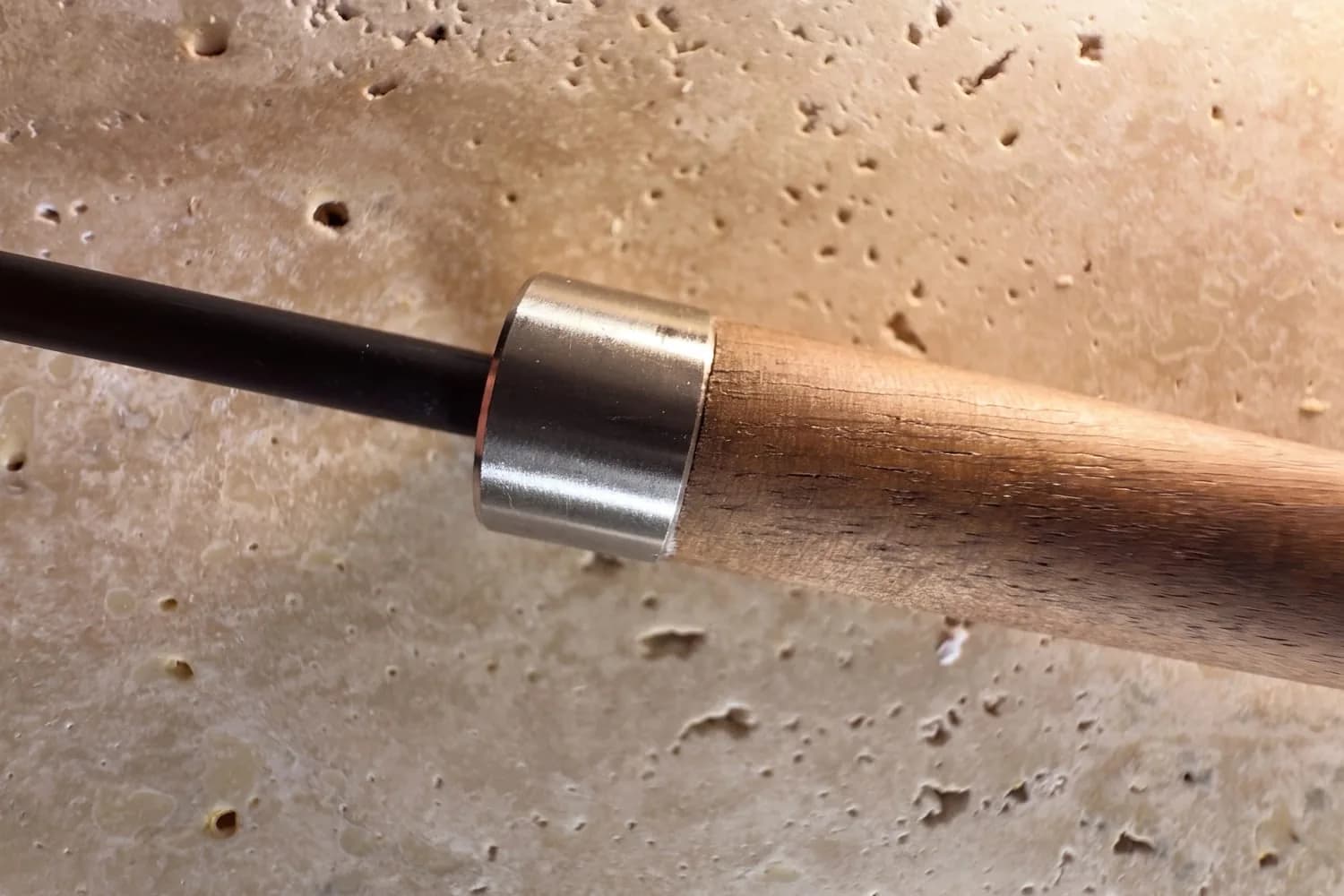
This is how we built The Chaser (opens in a new tab). Its rod is one seamless piece of solid fibreglass that tapers from 5 mm at the handle to 3 mm at the tip, and the cord and the Wren feather lure clip off so you can replace them. The craft page sets out each material.