
Cat Behaviour
What Your Cat Actually Wants From a Toy
If you've ever watched your cat ignore an expensive toy and play with a bottle cap instead, you've seen the gap between what humans think cats want and what cats actually respond to.
Cats don't evaluate toys the way we do. They don't care about colour, brand, or how much you spent. They're running a predatory assessment: does this thing move like prey? Is it the right size? Does it feel like something worth catching?
Prey drive isn't about hunger
This is the most common misunderstanding about cat play. People assume a well-fed cat shouldn't need to hunt or play aggressively. The opposite is true.
Research from the University of Exeter (Cecchetti et al., 2021) found that domestic cats continue hunting regardless of how well they're fed. Providing high-quality food reduced the number of prey animals brought home by 36%, and daily interactive play reduced it by 25%, but neither eliminated it. Hunting is neurological, not nutritional. It satisfies a drive that exists independently of appetite.
Indoor cats carry the same drive with nowhere to spend it. Nothing to stalk, nothing to chase, no unpredictable movement to react to. The instinct is intact; the outlet is missing.
This is why interactive play isn't optional for indoor cats. It's the only way to satisfy an instinct that's millions of years old.
Size matters more than you think
A review of cat play research (Delgado & Hecht, 2019) found that toy size is one of the strongest predictors of engagement. Cats consistently prefer toys roughly the size of their natural prey - about the size of a mouse or small bird.
Oversized toys trigger a different response. Instead of pouncing, cats tend to approach large toys cautiously, as they would a threat rather than prey. Those giant feathered teasers might look impressive to you, but to your cat, they may read as something to avoid rather than something to catch.
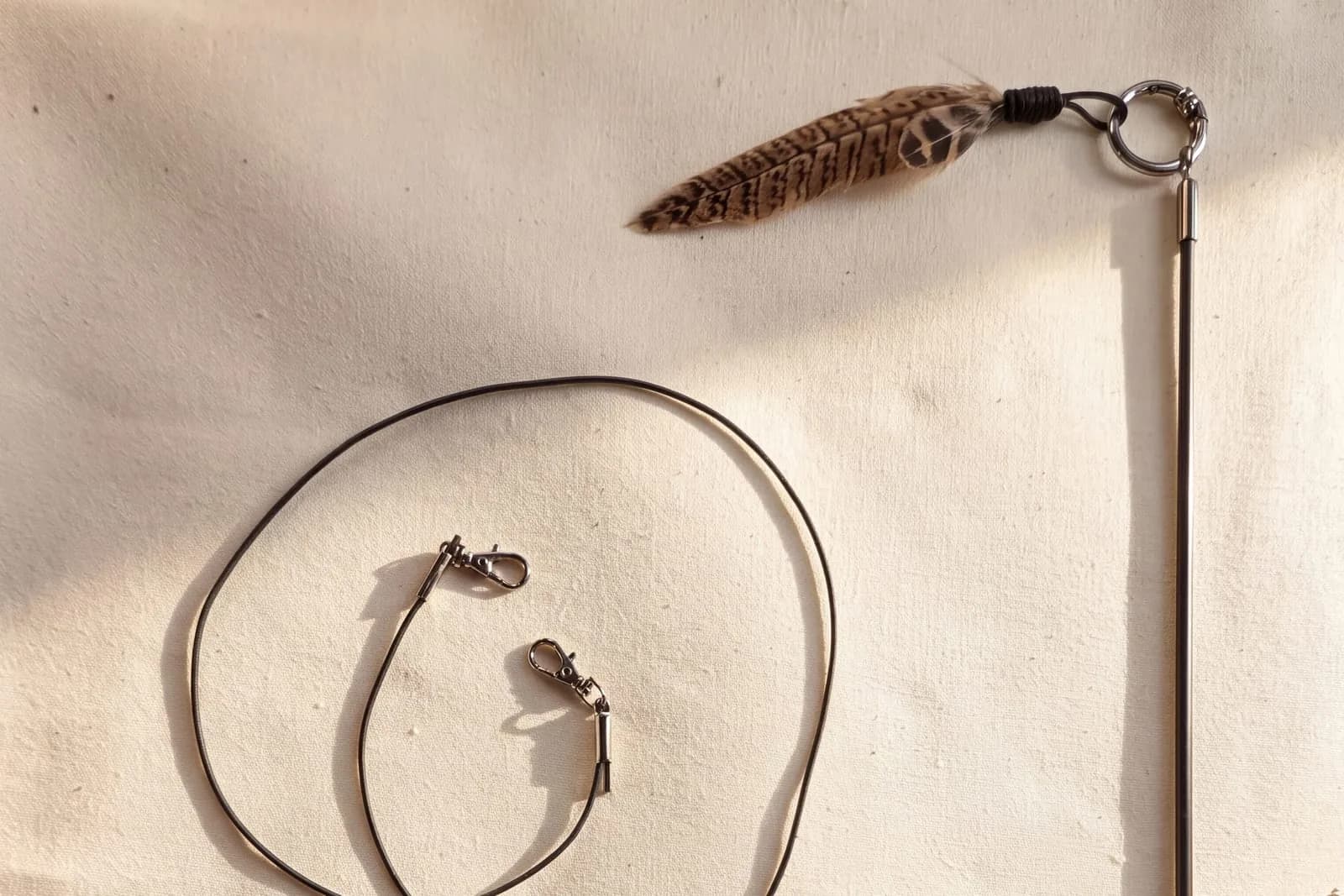
Small, lightweight attachments that move quickly and erratically get the strongest predatory response. That's why The Wren - the feather attachment that ships with The Chaser - is designed compact. Natural undyed feathers, sized to mimic a small ground bird. Big enough to see, small enough to pounce on.
Movement is everything
Cats respond to motion, not colour. Their visual system is tuned for detecting movement, particularly quick, irregular movements at the edges of their visual field. This is the flicker of prey in peripheral vision that triggers the stare-stalk-pounce sequence.
The best toy in the world, sitting still on the floor, is invisible to your cat's hunting instincts. The worst toy in the world, moving unpredictably across the ground, is irresistible.
This is why wand toys outperform almost every other cat toy category. The human controls the movement. You can mimic the stop-start darting of a mouse, the fluttering of a landed bird, the slow crawl of a beetle. You can move the attachment behind furniture and let your cat lose sight of it, which triggers the stalking behaviour that is, for many cats, the most satisfying phase of the hunt.
The Chaser gives you enough total reach to create realistic prey movement from a seated position. The prey can disappear around a sofa leg, dart across the floor, and flutter at ground level - all without you having to get up and chase your own toy around the room.
Texture and sound
Cats use more than vision to assess prey. Texture and sound play a role too.
Natural feathers outperform synthetic ones in most play tests. They're lighter, which means they move more naturally in the air. They produce subtle rustling sounds that mimic real bird movement. And they have a texture that's satisfying for cats to bite into. The keratin structure of a real feather feels different under teeth than plastic or polyester.
Crinkle materials trigger attention through sound. Fur-like textures trigger the kill-bite response. The best attachments combine multiple sensory triggers. A natural feather attachment like The Wren offers visual stimulus (feather movement), auditory stimulus (rustling), and tactile stimulus (feather texture under teeth). That's three sensory channels working together, which is why feather wands consistently rank as the most engaging toy category in play research.
What this means for choosing toys
The research points to a few clear principles.
Keep toys small and prey-sized. Choose toys that can be moved unpredictably by a human - not just battery-operated toys that repeat the same pattern. Natural materials (feathers, wool, leather) tend to outperform synthetic. Novelty matters, so rotate toys regularly and swap between different attachment types. And let your cat complete the full hunting sequence. Catching the toy is the reward.
A well-designed wand toy, used properly, is the single most effective play tool you can give an indoor cat. Not because the toy is special, but because it puts you in control of the prey behaviour - and that's what your cat is really hunting.
The Chaser was designed around these principles. Every material and detail exists because of what we know about how cats play, not because of what looks good on a shelf.