Materials & Craft
The Katije Design Philosophy
Katije exists because of a question that shouldn't be hard to answer: why does every cat toy look like it was designed for a child?
Walk through any pet shop and the cat toy aisle is a wall of neon plastic, cartoon prints, and glitter. The packaging screams. The materials feel disposable. Nothing in that aisle looks like it belongs in a design-conscious home, and nothing in that aisle is built to last.
This is the gap Katije was designed to fill.
Starting with materials, not marketing
When we started designing The Chaser, we didn't begin with a price point or a brand concept. We began with a question: what is the best possible material for each component of a cat wand?
Not the cheapest. Not the lightest. Not the easiest to manufacture. The best.
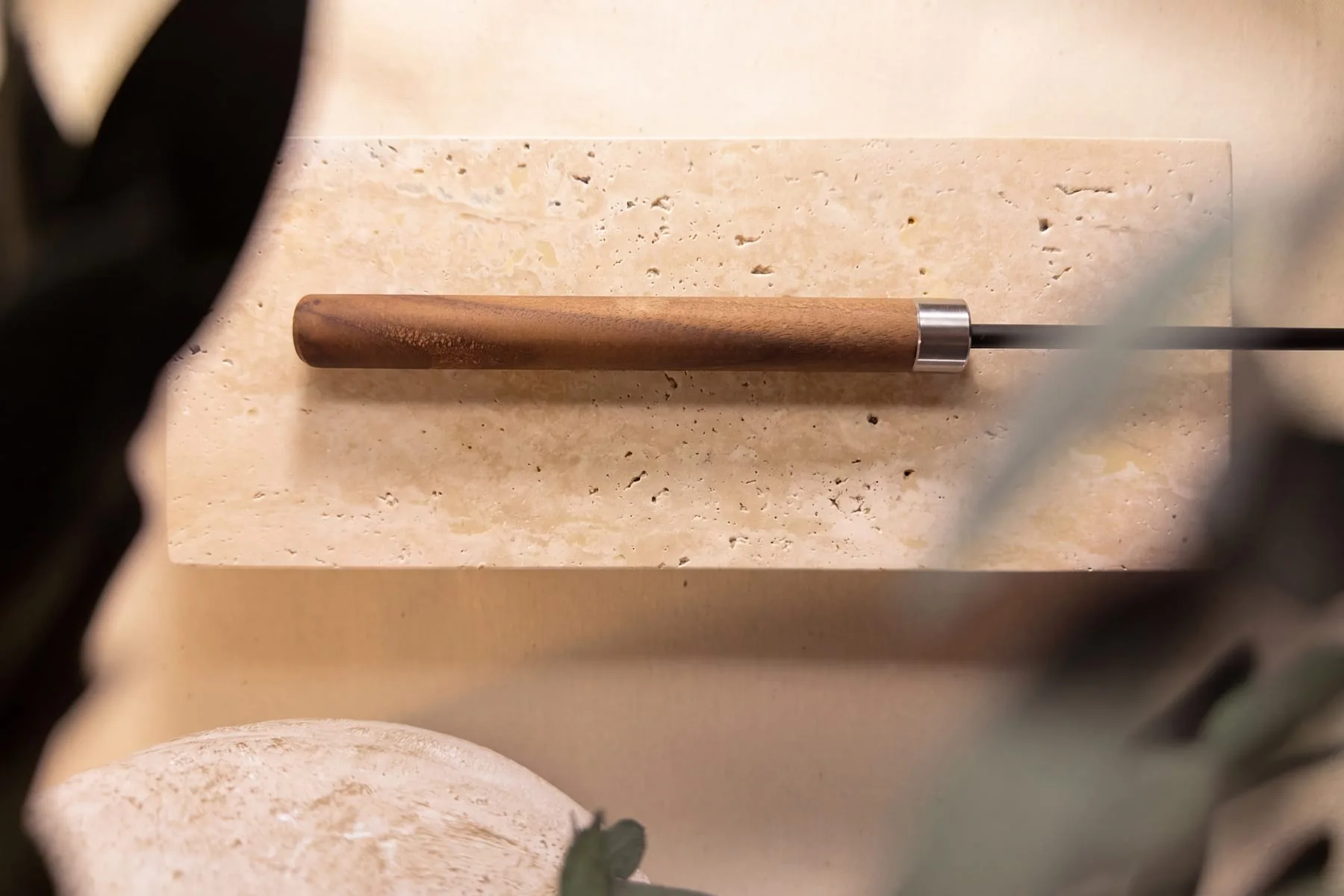
The handle: walnut. We considered and rejected beech (too bland), bamboo (too light, splinters over time), cork (compresses, absorbs oils), and various hardwoods. Black walnut won because of its combination of density, shock resistance, grain character, and feel. It has a Janka hardness of 1,010 - tough enough to resist daily handling wear, soft enough to feel warm and organic rather than cold and industrial. Walnut is what you find in the handles of chef's knives, heirloom furniture, and custom rifle stocks. It's a material chosen when something needs to last decades and look better with every year of use.
The rod: fibreglass. Carbon fibre is the material people expect in a premium product. It's the marketing-friendly option: lightweight, high-tech, expensive-sounding. But carbon fibre is the wrong material for a cat wand.
Carbon fibre's defining property is stiffness. It resists bending, and that's ideal for bicycle frames and drone arms, but a cat wand needs to flex. When a cat grabs the attachment and yanks sideways, the rod needs to bend and absorb that force rather than transmit it to the handle or the attachment point. And when the rod springs back, it creates the whipping action that makes the attachment move like real prey.
Fibreglass gives you that flex. It bends deeply under load and recovers its shape. It has superior fatigue resistance, meaning it can be flexed thousands of times without degrading. And when fibreglass does reach its failure point, it tends to fray rather than snap cleanly the way carbon fibre does, making it safer in a product used around animals.
The Chaser's rod is solid fibreglass, tapered so it's stiffer at the base and whippier at the tip. No joints, no telescoping sections, no weak points.
The cord: Dyneema. Most wands use cotton or nylon string. We use Dyneema - ultra-high-molecular-weight polyethylene. The same material used in yacht rigging, climbing equipment, and body armour. Up to 15 times stronger than steel on a weight-for-weight basis. It doesn't absorb water or saliva. It resists UV degradation and abrasion. And it doesn't stretch, which means your movements translate directly to the attachment without the lag you get from elastic or cotton cord.
Black Dyneema cord connects to the rod and to the attachment through swivel-bearing lobster clips - three 360° swivels across the wand in total, one at the rod tip and one in each clip. The swivels prevent twist buildup during play - the single biggest cause of cord tangling and premature failure in other wands. The lobster clips allow instant attachment swaps, no retying needed.
The attachment: The Wren. Natural undyed feathers, designed to the size and weight profile that behavioural research shows cats respond to most strongly. Compact, lightweight, and capable of realistic movement on the end of a whipping rod. Named after one of the smallest, quickest birds your cat would encounter in the wild.
The Cradle: walnut wall mount. Every Chaser ships with The Cradle, an adhesive walnut wall mount that holds the wand on any wall - out of the way when not in use. This isn't an upsell. It's part of the kit because storage is part of the product experience. A wand leaning in a corner looks like clutter. A wand mounted on the wall looks like it was designed to be there.
Design for homes, not pet shops
The colour palette across Katije is espresso, cream, sand, and terracotta. No neon. No cartoon prints. No plastic packaging with cutout windows.
The packaging is a cream box closed with a printed belly band, designed to present the product rather than just contain it. The unboxing experience is intentional. When something arrives looking and feeling premium, it sets the expectation for how it'll be used and cared for.
This isn't about being expensive for the sake of it. It's about respecting the fact that a cat wand lives in your home, gets handled daily, and sits on your wall between sessions. It should look like it belongs there.
One product, done properly
We could have launched with ten SKUs. A wand, a scratcher, a bed, a bowl, a collar. That's the standard playbook: fill a catalogue, hit every keyword, spread wide and see what sticks.
We launched with one product. The Chaser. One wand, one attachment, one wall mount. Because doing one thing properly is harder and more valuable than doing ten things adequately.
Future attachment drops are planned to extend The Chaser's versatility over time - with different prey profiles, textures, and movement characteristics. But the wand itself is the platform. It's the thing we got right first.
Katije isn't trying to be the biggest cat toy brand. We're trying to be the one that people who care about design, materials, and their cat's experience choose when they're done replacing disposable plastic.
Pre-order The Chaser at Katije.com.